
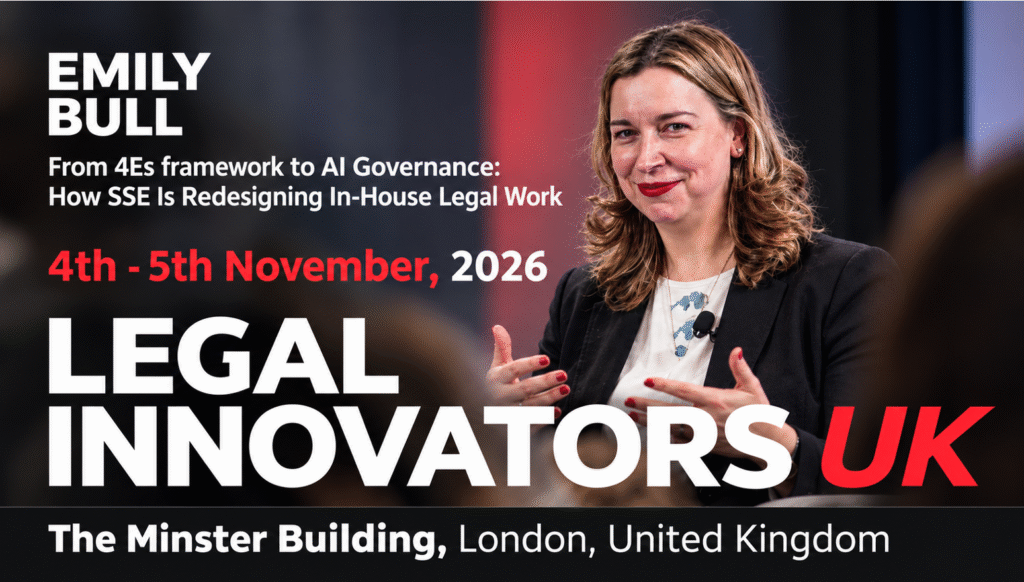
For Emily Bull, Director of Legal, Property, Planning and Consenting at SSE – and a speaker at Legal Innovators UK on Inhouse Day, November 5th, next week – a key part of her approach to the use of AI in the inhouse team is the 4Es test: can a task be Eliminated, Enabled for someone else to do, Engineered into a better process, or does it genuinely require a lawyer’s Expertise?
Over the past year, she has been applying that mindset while redesigning legal delivery across her team and leading SSE Legal’s work on AI adoption and governance.
Ahead of Legal Innovators UK 2026, the events team spoke with Emily about practical legal transformation, responsible AI adoption, and why human judgment remains central.
To hear Emily and many other great speakers next week at Legal Innovators UK, at the Minster Building in London, Nov 4 and 5, please follow the link below to pick up your express tickets. Complimentary passes are for those working inside law firms and within corporate legal teams.

As you’ve worked to transform how legal services are delivered, how did you identify the areas that needed improvement, and what principles guided where you started?
We didn’t start with a huge mapping exercise. I know that’s the conventional wisdom, but when people are busy and you’re trying to build momentum, it can become a barrier to getting started. There is absolutely a place for proper process design, but you can spend a long time planning the perfect future state when sometimes you learn more by just starting.
Instead, we looked at what was actually coming through the door, picked something relatively small and tried it. For us, that meant building a comprehensive picture of the work going on across the team, but the right starting point will vary from organisation to organisation.
That overview led me to what’s become my guiding test, which I think of as the Four Es: can we Eliminate the task, Enable someone else to do it, Engineer a better way of doing it, or does it genuinely need a lawyer’s Expertise?
We started with technology we already had access to and learnt by doing. The first attempts weren’t particularly pretty or user-friendly, but we shouldn’t be afraid to iterate.
Where do you see the greatest potential for AI to improve property and energy legal work, and which tasks should remain firmly under human control?
Property and energy work can be incredibly document-heavy, so there are obvious efficiency gains, for instance first-pass reviews of titles or land agreements.
The real opportunity, however, is where AI allows us to redesign how some of that work is delivered, and improve the experience of our stakeholders by doing so, rather than simply doing the same work faster.
The human role remains particularly critical where judgement and relationships are involved. The technically correct legal answer isn’t always the right commercial answer, and AI doesn’t and can’t have accountability for that decision or the wider context behind it.
For me, that’s the important line: use AI to help lawyers get to the judgement more efficiently, but keep a human being accountable for the work and the outcome. Nuance is often the critical factor on a deal, and understanding that wider context remains incredibly important.
In your experience, what are the biggest reasons lawyers resist new systems or ways of working, and how can leaders distinguish between resistance rooted in habit and legitimate concerns about quality or risk?
I think we sometimes badge something as resistance when the real problem is lack of time or headspace. People are busy, and a new way of working usually takes effort before it saves any. AI and innovation tend to fall squarely into the “important but not urgent” camp, so can easily fall by the wayside. There can also be perfectly legitimate concerns around accuracy, confidentiality and accountability.
If the issue is simply unfamiliarity, make the first step small and useful. I’m personally terrible at meeting notes. I find it really hard to take notes in any detail and contribute at the same time. That was therefore a really helpful entry point for me, and it’s still my favourite example because nobody particularly enjoys producing meeting notes, but everybody values good ones afterwards.
Ultimately, a useful result from a colleague will persuade people far more effectively than me telling them they should embrace technology.
Could increased reliance on AI create new forms of professional risk, such as automation bias, declining verification skills, or the loss of institutional knowledge?
All three are genuine potential issues, but declining verification skills concerns me particularly because it could happen quite quietly. Nothing necessarily goes obviously wrong, we just become a little less practised at checking things ourselves while increasingly trusting output that looks convincing.
There’s an interesting tension here: AI can produce more material, more quickly, so we need skilled reviewers at exactly the same time that it may reduce some of the work through which people traditionally developed those skills.
That’s particularly important for junior lawyers. If AI takes away some of the work through which previous generations learnt their craft, we need to be much more deliberate about how people develop judgement.
But I can also see an opportunity here. Used well, AI gives junior lawyers something they can question, challenge and debate in a way that could actually help develop that judgement. The important thing is that we’re building the judgement muscle rather than outsourcing it.
The answer isn’t to avoid AI. It’s to build verification into how we use it, maintain good underlying knowledge and make sure lawyers remain capable of challenging the answer they’re given.
What insights do you hope the audience will take away from your session at Legal Innovators UK?
I’d like people to leave feeling that the barrier to starting is lower than they might think. You don’t need the perfect operating model or an enormous technology stack before you can start solving real problems. Some of the most useful things we’ve done started very simply.
I’d also like us to separate legal operations from AI. AI is incredibly exciting, but it’s only one part of the bigger question of how legal work gets done: what comes into Legal, who should do it, how we reuse what we already know and how we make things easier for our stakeholders.
Most legal teams already have really good lawyers. The opportunity is to create the environment around them that lets them spend more of their time doing the things they’re uniquely good at.
Nobody has all of this figured out. I actually find that quite reassuring. We can start, learn and improve.
Emily’s perspective offers a practical model for legal transformation: start with the work, not the technology. The 4Es framework provides a simple way to decide what should disappear, move elsewhere, be redesigned or remain with a lawyer, while AI can support judgement without replacing accountability.
At Legal Innovators UK 2026, Emily will build on these themes, exploring how in-house teams can improve legal delivery while adopting AI responsibly.
Join us at Legal Innovators UK on 4–5 November 2026 at The Minster Building, London
And to hear Emily and many other great speakers next week at Legal Innovators UK, at the Minster Building in London, please follow the link below. Complimentary passes are for those working inside law firms and within corporate legal teams.
Interview by Emma Nguyen, Marketing Executive at Cosmonauts
Discover more from Artificial Lawyer
Subscribe to get the latest posts sent to your email.