
By Jean-Rémi de Maistre, CEO, Jus Mundi.
Arbitrator selection: a consequential decision, a fragmented process
Arbitration is a consensual dispute resolution mechanism widely used to resolve international disputes. One of its defining features is the ability to choose the arbitrator or arbitrators who will decide the dispute. This makes arbitrator selection one of the most consequential decisions in a case, where billions of dollars may be at stake.
In light of the specific requirements of a case, parties, counsel, and institutions must assess a candidate’s professional background, expertise across relevant issues and jurisdictions, language skills, and potential conflicts. For a three-member tribunal, they must also consider the dynamics among its prospective members. These judgments draw on multiple sources, requiring quantitative data, qualitative insights and feedback to be weighed critically against the candidate’s documented record. Overlooking relevant information can expose an appointment to challenge, disrupt proceedings and increase costs.
Yet this process still depends largely on time-consuming manual research, internal know-how, and word-of-mouth. Comparing candidates requires assembling information scattered across professional profiles, case records, publications and other sources, while indirect relationships and circumstances warranting further investigation can be difficult to identify.
Further, reliance on familiar networks may narrow the candidate pool. Jus Mundi’s analysis of major arbitral institutions’ 2024-2025 statistics reported that female arbitrator appointments accounted for 35%-46% of direct institutional appointments, and only 17-24% of party nominations. While appointment considerations vary across institutions and cases, these figures underline the continuing challenge of improving arbitrator diversity.
AI can significantly reduce the time needed to identify and compare potential arbitrators. But the opportunity goes beyond efficiency: it helps practitioners weigh multiple dimensions of a candidate’s suitability against the needs of the case and consider candidates outside their usual networks. Used responsibly, this could support better-informed and fairer appointments.
Why arbitrator selection remains a complex challenge for legal AI
Realizing that potential, however, requires more than general-purpose AI that can generate a list of names. Arbitrator selection retains all the complexity of AI-powered legal research while adding another layer: informing an assessment of a person’s professional suitability, with implications for both proceedings and reputation. Three closely connected challenges are particularly important.
The first is assembling a reliable, multidimensional evidence base. Unlike research focused on legal authorities, arbitrator selection requires connecting a practitioner’s qualifications and professional background with publications, case experience and relationships. Relevant evidence may sit in a profile, an article or an award, each establishing something different. A system must locate these sources, verify that they concern the right person, assess their reliability and bring them together against case-specific criteria.
The second is assessing that evidence without overstating it. A previous appointment may establish experience, but does not, by itself, establish suitability for another dispute. A system must also distinguish an arbitrator’s individually expressed views (for example, in publications or awards issued as sole arbitrator) from the collective reasoning of tribunals on which they sat.
Arbitrator selection remains more an art than a science: evidence informs the decision but cannot resolve every question of fit.
The third challenge is ethical. Inaccurate answers can misrepresent a practitioner’s work, while discrepancies in the availability of information can make better-documented candidates appear more qualified. Algorithmic bias presents a distinct risk: a system may unintentionally reproduce historical prejudices or reinforce existing appointment patterns. Systems also need safeguards against potential discriminatory uses, such as appointment preferences that may introduce unjustified exclusion, alongside careful treatment of personal and professional information.
Failures in any of these areas can mislead appointment decisions, unfairly damage a practitioner’s reputation, and undermine trust in AI-assisted selections. The challenge, then, is not simply to generate a shortlist faster. It is to support a consequential decision with reliable, transparent evidence, appropriate caution and clear ethical boundaries.
How specialist AI can support informed and inclusive selection
Specialist legal AI can make the process more informed, supporting judgment rather than replacing it. Specialized data matters, but so does how a system uses it. Among the core design considerations are the following:
- Recommendations should be explainable, not presented as verdicts. Users should see why a practitioner appears relevant and follow supporting information to its source. Comparisons should organize evidence around case-specific criteria, not declare one objectively “best” or reduce different strengths to a falsely precise score.
- Uncertainty should remain visible. Systems should distinguish documented facts from inference, flag gaps in coverage and make clear where direct confirmation or professional judgment is needed. Missing information is not evidence that someone lacks experience
- Inclusion should be built into the approach, not an afterthought. Systems should help users explore beyond familiar networks and apply relevant criteria consistently, without narrowing the candidate pool through unnecessarily restrictive interpretations. For example, relevant industry experience may come from acting as counsel, not only from previous arbitrator appointments.
A carefully designed system, therefore, can use specialized data to help practitioners discover relevant candidates and find and assess supporting evidence more efficiently and reliably.
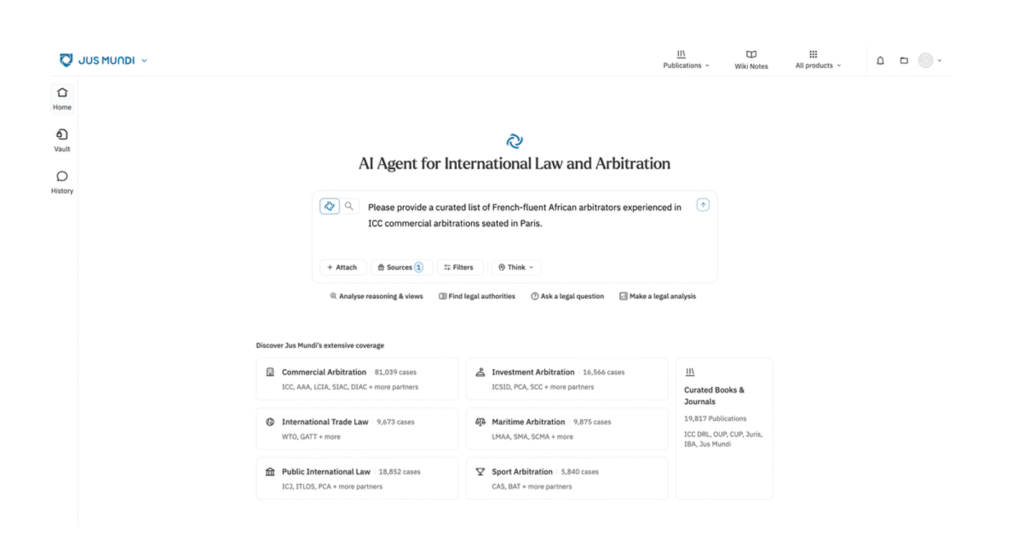
Developing responsible arbitrator search at Jus Mundi
These considerations, reflected in our AI Manifesto, guide our development of arbitrator search capabilities in Jus AI, Jus Mundi’s agentic AI for international arbitration.
Announced on 27 October 2026, the private beta release focuses on two stages: identifying practitioners against case and appointment criteria, and researching named candidates before nomination, acceptance or objection.
At the heart of these capabilities is Jus Connect, with thousands of data-backed professional profiles. Together with Jus Mundi’s arbitration materials, these profiles provide the foundation for identifying, comparing and researching candidates. Users can also bring their own documents into the research through My Sources.
Supporting these capabilities responsibly requires more than data. Jus AI combines Tenet v5, our proprietary LLM purpose-built for arbitration, with an agentic architecture and lawyer-led quality assurance. Its answers include citations to support verification and flag information gaps and partial coverage. Guardrails define what the system answers, when it qualifies a response, and what it declines to answer.
As a mission-driven company, Jus Mundi believes that responsible AI-assisted arbitrator selection should be developed in dialogue with the arbitration community. Through the private beta, we intend to invite members of our Mission Committee, clients and partners, and organizations with expertise in diversity and professional standards to help test and challenge the approach. Their feedback will help shape both the product and its safeguards.
This beta is the first step toward giving practitioners a stronger foundation for arbitrator selection, with future development focused on deeper analytics and more integrated conflict-checking workflows. The aim is broader visibility, better evidence and a more efficient starting point, supporting a fairer, more open appointment process and, ultimately, greater confidence in arbitration as a dispute resolution mechanism.
Learn more about Jus AI and its arbitrator search capabilities here.

–
[ This is a sponsored thought leadership article for Artificial Lawyer by Jus Mundi. ]
Discover more from Artificial Lawyer
Subscribe to get the latest posts sent to your email.